
The value of research isn't in how big the insight is. It's in what you can do with it.
Businesses have always used research to understand customers, identify opportunities, reduce uncertainty, and make better decisions. How these activities relate has transformed in recent years as the distance between knowing and doing has gotten ever-shorter. Today, research is expected to do more than uncover an interesting insight. Teams we work with frequently need to move directly from what they learn to strategic decisions—often involving multiple stakeholders, and in organizations where priorities are constantly shifting.
Making our insights actionable is not a nice to have; it’s a given. Research needs to be designed from start to finish with what the business needs to decide and what will be required to act on what is learned as its prime directive.
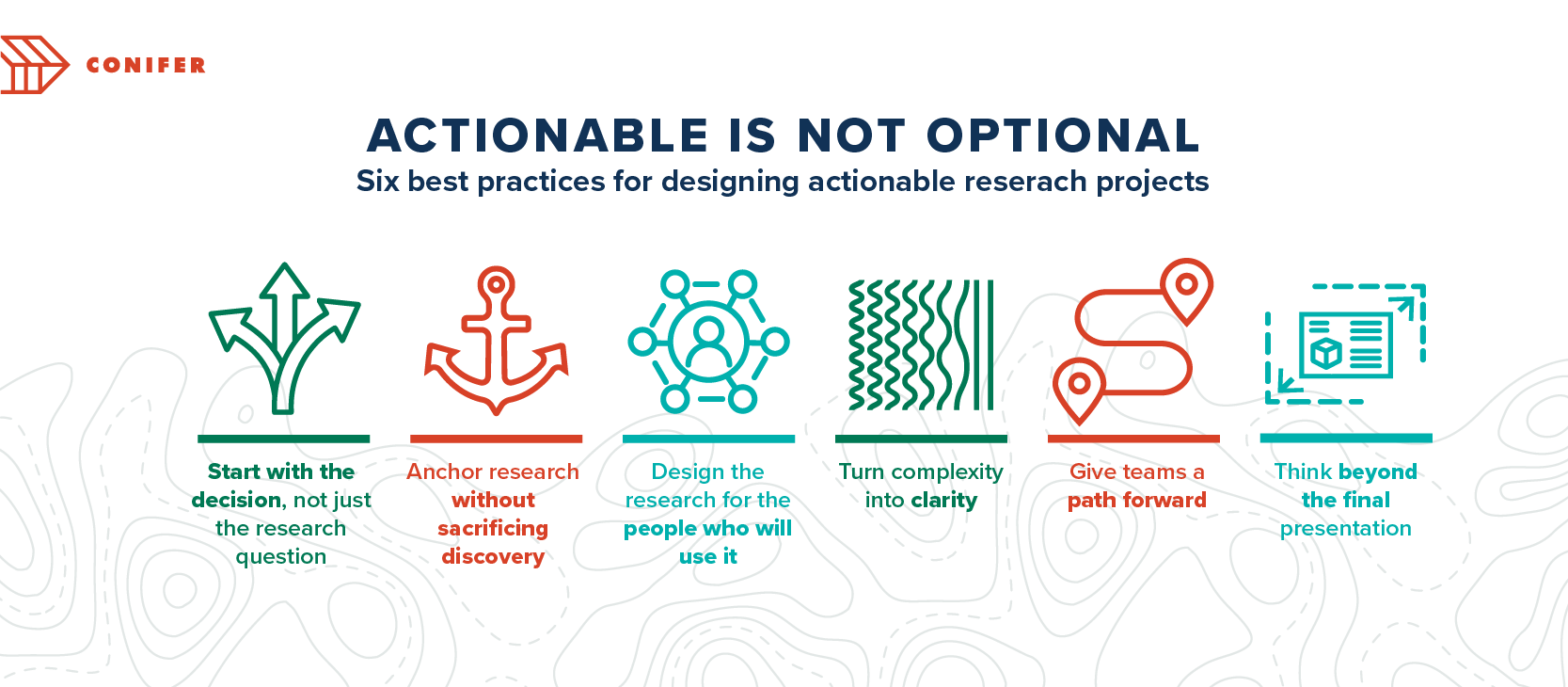
To serve our clients' need for action, we have developed six best practices when designing any project.
Start with the decision, not just the research question

We begin before we begin, so to speak. We know that the RFPs we receive have a job to do—to tell us what a client wants to learn and what they expect to receive at the end of a project—but there is more to designing a successful research plan.
RFPs rarely convey the full organizational context surrounding the work. So, during the proposal and planning phases, we spend time understanding the world our work will have to live in: Why is this project happening now? What decision is it intended to inform? Who will need to use the findings? What are their different priorities? Where might there be competing perspectives or constraints?
Understanding these things early helps ensure that the research is designed for the reality in which it will be used—not just the brief on the page.
Anchor research without sacrificing discovery
 The best research balances what you know you need to understand with what you don't yet know you need to understand. Some of the most valuable, provocative findings are the ones that weren’t anticipated. These push teams to challenge their thinking and require a willingness to go beyond assumptions. Yet, this can be challenging amidst tight timelines and narrow objectives. Fortunately, there is a difference between being open to discovery and being unfocused.
Ethnography, for example, is powerful because it allows us to see behaviors, motivations, and needs in context and beyond what people can simply articulate. So, we establish a clear focus — the strategically important learnings — and then create space to explore what might be around, behind, and beneath those core questions.
The goal isn't simply to find something interesting. It's to discover something that could change the way you think, decide, or act.
Design the research for the people who will use it
 There is rarely one audience for research. A product team may need to understand what a finding means for product design. Marketing may see implications for positioning and communications. A strategy team may see a new market opportunity. While the underlying research is the same, what each team needs from it is different.
That's why we think about our clients almost as carefully as we think about the people we research. Understanding the audience for the research helps us determine how findings should be framed, what evidence matters most, and what will make the work meaningful to the people who use it. This may mean different deliverables with different strategic focus or separate touchpoints to engage the right teams at the right moments.
Turn complexity into clarity
 Human behavior is rarely simple, and good research shouldn't pretend otherwise. Yet, complexity and nuance need not be unclear or indirect. The people who will use the research are busy making decisions. They need to understand what is happening, why it matters, and what it means for the business. Our job is to do the hard work of synthesis—to turn rich, often complicated evidence into insights that people can understand, remember, and use.
Rigor and clarity aren't opposites. The best research delivers both.
Give teams a path forward
 There is no single formula for actionable recommendations. Sometimes a team needs a clear recommendation. Sometimes it needs a set of opportunities to explore. Sometimes the most valuable outcome is identifying a tension or assumption that the organization needs to confront.
The right level of direction depends on the decision, the organization, and the people who will ultimately own the next step. But the objective is always the same: Move the organization from “This is what we learned” to “We know what this means for us and here’s what we do with it.”
Think beyond the final presentation
 There is an opportunity to extend the value of research beyond the project itself. As AI and other technologies make it easier to access, connect, and synthesize information, research can become part of an organization's ongoing understanding of its customers. When research is well-structured, teams can easily find it, integrate it with other customer data, revisit it when new questions arise, and build on it over time. Teams can easily find it, integrate it with other customer data, and revisit it when new questions arise.
The research project may end, but the value of what you learned doesn't have to.
Research should make the next decision better. Actionable research isn't about forcing every finding into a recommendation or rushing from research to action. It's about designing the work with its eventual use in mind. It means understanding decisions and actions before designing the research. Creating focus without closing off discovery. Making complex findings clear. Calibrating the work to the people who need to use it. And giving teams enough direction to move forward with confidence. At Conifer, we believe research should do more than tell you something you didn't know. It should help you see the business differently—and make the next decision better.